In 2023, Sam Altman told The Atlantic: "Jobs are definitely going to go away, full stop." In May 2026, the same Sam Altman told Reuters he was "delighted to be wrong about this" - the impact on entry-level white-collar jobs had been smaller than he expected. He is not the only one who has changed his message.
The useful signal is not that one prediction replaced another. It is that people closest to the technology cannot offer a stable forecast. A small business should not build a workforce plan around either version.
What the CEOs said then - and what they say now
The reversal is broad and well documented.
Sam Altman (OpenAI). From "my job is to help people destroy jobs" (2015) and "jobs are definitely going to go away, full stop" (The Atlantic, 2023) to "I'm delighted to be wrong about this" (Reuters, May 2026).
Mustafa Suleyman (Microsoft AI). At Davos in 2024, AI models were "fundamentally labour-replacing tools". Earlier this year he predicted most white-collar tasks would be "fully automated by an AI within the next 12 to 18 months". By June 2026, the framing had changed: "I said 'tasks'. So that does not mean jobs… Jobs and roles are the broader category, and tasks are the components of that" (The Verge).
Jensen Huang (Nvidia) now warns against the warners: "If we discourage people from being software engineers, we're going to run out of software engineers… The job of a radiologist is patient care. The task is to read a scan" (Dwarkesh Podcast).
The new script is more careful: AI changes tasks first, while the effect on whole jobs depends on how companies reorganise around those tasks.
What the data says
Here is where it gets uncomfortable for both versions of the story.
The layoffs have not stopped. Microsoft eliminated around 4,800 roles in July 2026. Amazon cut approximately 16,000 roles in January, describing a push to reduce layers and bureaucracy. Neither announcement proves that AI directly replaced those people. It does show why reassurance from the same industry cannot be treated as labour-market evidence.
At the same time, the apocalypse has plainly not arrived. A Ramp and Revelio Labs study found that firms spending the most on AI are adding headcount faster than slower adopters. Ford has been rehiring engineers to fix quality problems that automation could not solve. And the share of CEOs who expect AI to reduce their headcount fell from about 46% in January 2025 to 24% in December 2025, according to EY-Parthenon.
Both things are true at once: some large companies are cutting jobs while adopting AI, and the broader labour market has absorbed the technology far better than the 2023–2024 predictions suggested.
Why the message changed
Three explanations, none mutually exclusive.
First, the predictions were simply early or wrong, and executives are adjusting to evidence - Altman's own reading. Second, public opinion has turned: more than half of Americans fear AI will cost someone in their household a job (Reuters/Ipsos, June 2026), and companies selling AI need the public not to hate it. As an MIT economics professor told the Wall Street Journal, it is "simply bad business to say that your great new product will destroy the economy." Third, many companies that bought the automation promise found the technology harder to apply than advertised, and are quietly rehiring.
None of these explanations requires anyone to be lying. But none of them means the reassurances are a forecast you can rely on, either.
The small-business question is capacity
Most of this debate is about companies with thousands of employees and management layers to flatten. If you run a business of up to 50 people, the replacement question mostly misses the point - and that changes the conclusions.
You have no spare capacity to cut. In a lean team, nobody's job is "the task AI automates"; everyone's job is a bundle of twenty things held together by context. What AI changes for you is capacity: the same team handling more clients, faster quotes, less admin. The realistic comparison is not "person vs machine" - it is your ten-person firm with well-applied AI against a competitor's ten-person firm without it.
That cuts both ways. The pressure on your business will not come from AI. It will come from competitors who learnt to use it while the headlines argued about robots.
The operational conclusion
The CEOs were wrong loudly in 2023 and are now correcting quietly in 2026, and the truth was never at either extreme. Task automation is real; job replacement in small firms is mostly a distraction. What we see in practice is that the businesses getting value from AI are the ones treating it as an operations upgrade - unglamorous, specific, measured - not as a workforce strategy.
Where we'd speculate (and this is opinion, not evidence): within a couple of years the question "will AI take our jobs?" will sound as dated in small-business conversations as "should we have a website?" did in 2010. The dividing line will not be adoption - nearly everyone will have the tools - but competence: whether anyone set them up properly, connected them to real processes, and kept the data safe. That gap is already visible, and it favours small firms that start deliberately over large ones that start loudly.
What to do now
Nothing on this list requires buying anything this week.
- Ignore both narratives in your planning. Neither "AI takes all jobs" nor "AI threatens nothing" is a business plan. Your plan is: which three tasks in your business eat the most hours, and can a tool reliably shorten them? If you want concrete starting points rather than theory, we listed five AI automations any small business can set up this week.
- Talk to your team before they read about it. People assume the worst quietly. Being clear that AI in your business means removing drudgery, not people, costs nothing and prevents the quiet CV-updating that actually does damage.
- Train before you hire. Your staff's knowledge of your customers and processes is the hard part. Tool skills can be taught in weeks.
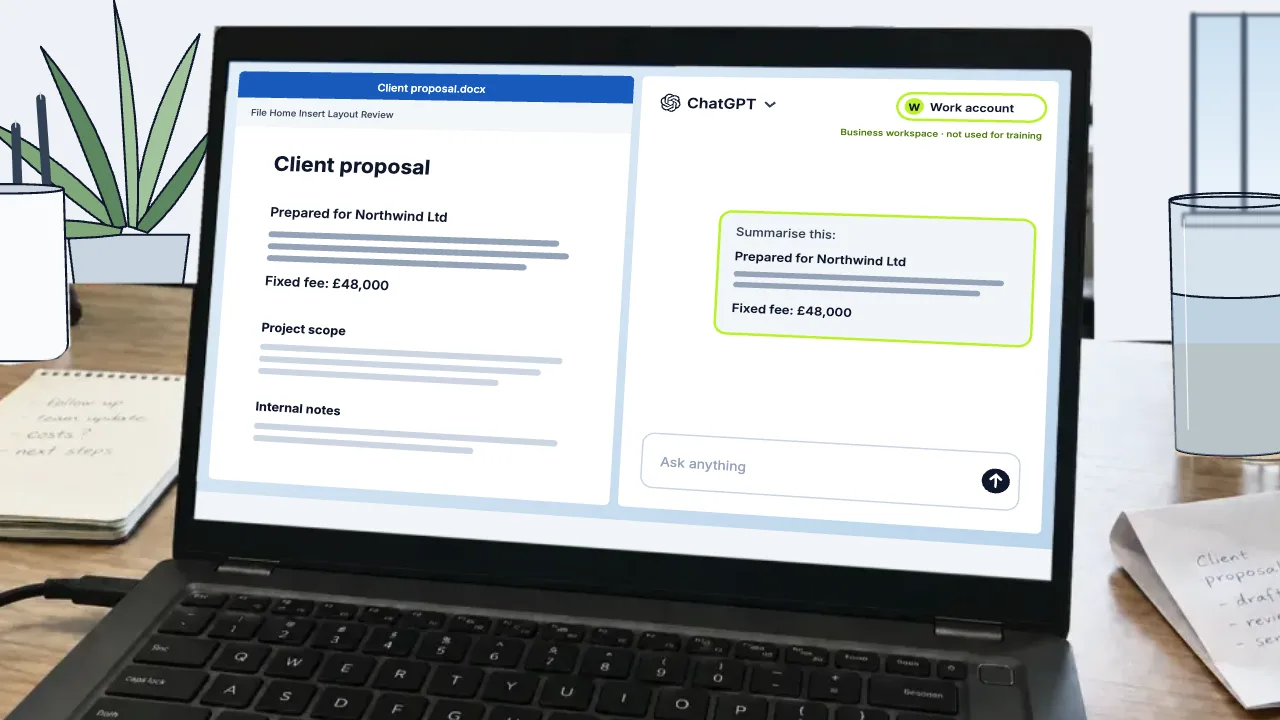
- Mind what goes into the tools. Staff experimenting with AI on their own accounts are already pasting company data somewhere you cannot see. A one-page policy on what may and may not go into public AI tools is the cheapest risk reduction available this year.
The people building AI do not know exactly how this plays out - their own forecasts moved sharply within three years. You do not need a grand forecast either. You need a business that tests specific uses, measures what changed and stops what did not work.
Sources
- Reuters - OpenAI's Altman says AI unlikely to lead to jobs apocalypse (26 May 2026)
- The Atlantic - Does Sam Altman Know What He's Creating? (2023)
- The Verge - Mustafa Suleyman interview (June 2026)
- Dwarkesh Podcast - Jensen Huang
- Microsoft - The latest in our company transformation (6 July 2026)
- Amazon - Update on our organisation (28 January 2026)
- Ramp / Revelio Labs - AI's impact on jobs
- Reuters/Ipsos poll (10 June 2026)
If you're weighing up what AI could realistically do in your business - or what it shouldn't - we're happy to talk it through.